

Unrepresented Nations and Peoples Organization (UNPO)
Re-imagining Self-Determination and XIX General Assembly
(35th Anniversary)
27 – 30 August 2026, The Hague, Netherlands
Resolution on Chittagong Hill Tracts
Taking note that, Chittagong Hill Tracts (CHT), the south-eastern region of Bangladesh, is an abode of 14 different indigenous ethnic groups who collectively identify themselves to be a ‘Jumma’ (High Landers) peoples. The indigenous Jumma peoples of 1 million population possess an entity absolutely different and mismatching to the Bengalees, the greater community people of Bangladesh in respect of governance system, ethnical identity, language, culture, custom and practices.
Recognizing that, the CHT had been being governed as a ‘Special Administrative Region’ since a particular time of the history. During the colonial British rule, the region was administered as an ‘Exclusive Area’, which also remained in affect up to certain extent of time during Pakistan period. But during Bangladesh time, despite strong demand of the Jumma peoples, the ‘Special Administrative System’ of CHT has not been accommodated with due recognition in the Constitution. Furthermore, in 1980s, more than 4 lakhs of Muslim Bengali people were settled down in the lands owned by the Jumma peoples at government’s initiative, with a mean objective to marginalize the indigenous Jumma peoples.
Affirming that, in 1970s, the Indigenous Jumma peoples embarked upon an indomitable movement to re-assert their robbed rights to self-determination. After waging a determined struggle for three decades, with an aim to resolve the CHT problem through political and peaceful means, the historic treaty called ‘CHT Accord’ was signed between government of Bangladesh and Parbatya Chattagram Jana Samhati Samiti (PCJSS) on 2nd December 1997. The Accord contains some of the significant provisions, such as, recognition of CHT as a tribal-inhabited region; introduction of ‘Special Administrative System’ to CHT; demilitarization and withdrawal of all the temporary camps; rehabilitation of the Jumma refugees and internally displaced Jumma families; returning the dispossessed lands to the Jumma land owners through the Land Commission; rehabilitation of the Muslim Bengali settlers outside CHT with dignity and honor, etc.
Concerning that, even though passing 29 years after signing of the CHT Accord, two-third sections of the Accord including the core issues have not yet been implemented. As a result, political and peaceful resolution to the CHT problem has not yet been achieved and that the ‘Special Administrative System’ incorporating the CHT Regional Council and three Hill District Councils could not have been properly established.
Considering that, it is due to non-implementation of the CHT Accord, the Human Rights situation in CHT could not prosper as such. Instead of persuading political and peaceful means to resolve the problem, the successive governments of Bangladesh have been exercising the policy of wide-scale militarization and suppressive measures in fascist manner. In global context, CHT is regarded to be the most militarized region. There are more than 400 temporary military camps including the ‘de facto’ military rule ‘Operation Uttoron’ in active in CHT. Consequently, the military atrocities that remain effective and unabated include: oppressive measures upon the Jumma peoples; human rights violation; terrorist actions upon the pro-Accord and innocent Jumma people dealt by the army-backed terrorist armed groups; tagging the individuals and organizations engaged in the movement for implementation of CHT Accord as ‘terrorists’, ‘arms holders’ ‘separatists’, etc. and thereby putting them under criminalization process; unleashing communal attacks upon the Jumma peoples by inciting the Bengali settlers and Rohingya refugees; making out undue harassment; illegal occupation of lands owned by the Jumma people; intensifying anti-Accord activities; covertly and overtly religious conversion, violence against indigenous women and girls, etc.
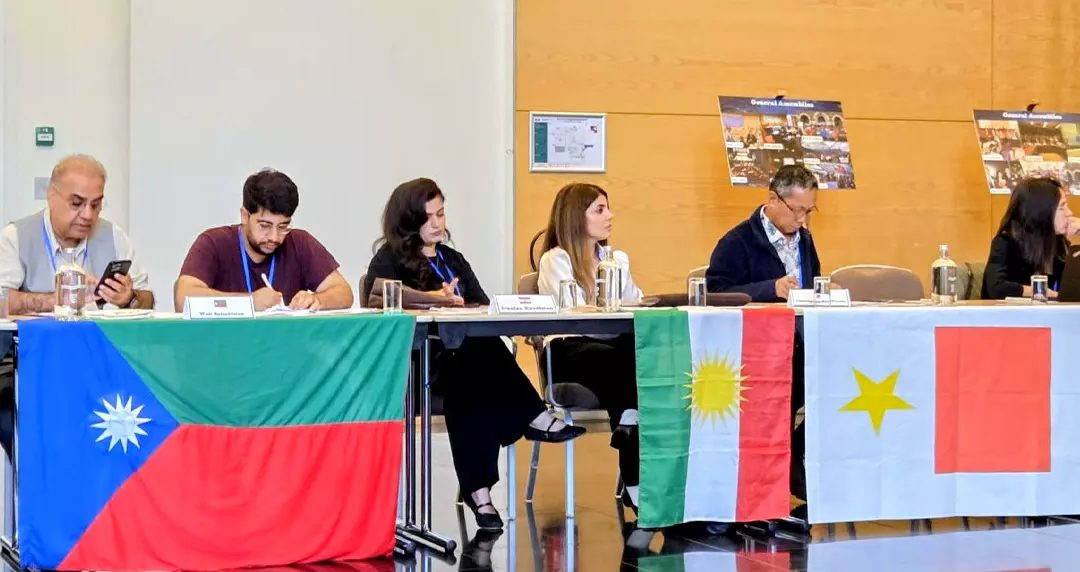
In light of the situation mentioned as above, the XIX General Assembly of Unrepresented Nations and Peoples Organizations (UNPO) held on 29-30 August 2026 in The Hague, Netherlands, having solemnly passed the proposals, do hereby calls upon all the concerned as follows:
-
To the Government of Bangladesh:
(1) To declare a time-bound plan of action (Road Map) for implementation of the CHT Accord of 1997;
(2) With an objective to demilitarize the CHT, to withdraw all the temporary camps including the de facto military rule conferred under ‘Operation Uttoran’ from CHT; and
(3) To formulate ‘CHT Land Dispute Resolution Commission Regulation’ and having all the disputes of lands resolved, to return the dispossessed lands to the Jumma peoples.
-
To the International Community:
(1) To exert political, diplomatic and financial pressure upon the government of Bangladesh directing to implementation of the CHT Accord;
(2) To ensure that no army personnel involved in human rights violation in CHT gets appointed in UN Peacekeeping Missions; and
(3) To take an initiative to send the UN Special Rapporteur on the Rights of Indigenous Peoples to CHT for physical investigation of Human Rights situation in CHT.
-
To all the Political Parties and Civil Society of Bangladesh: