

Following its two-thirds majority victory in the Jatiya Sangsad (national parliamentary) election held on February 12, 2026, the Bangladesh Nationalist Party (BNP), led by Tarique Rahman, formed the government. On February 17, 2026, Dipen Dewan—elected from the Rangamati constituency—was sworn in and appointed Minister of Chittagong Hill Tracts (CHT) Affairs, a move that was both consistent with the CHT Accord of 1997 and widely desired. However, on the same day, Mir Mohammad Helal Uddin—a Member of Parliament (MP) from the Chattogram-5 constituency and a member of the Bengali community from outside the CHT region—was appointed State Minister for CHT Affairs Ministry; this appointment was entirely inconsistent with the core spirit of the Accord. Although civil society in Bangladesh, including the people of the CHT, demanded the removal of Mir Mohammad Helal Uddin from the CHT Affairs Ministry, the government took no action. Even more concerning is that on June 1, just 102 days into his tenure, Dipen Dewan was forced to resign following various forms of pressure. Since then, no member of the Jumma community has been appointed as the Minister for CHT Affairs Ministry. Currently, in violation of the CHT Accord, the BNP government is illegally running the Ministry of CHT Affairs through Mir Mohammad Helal Uddin.
A matter of further concern is that Minister Salauddin Ahmed, Ministry of Home Affairs, on March 11, 2026, while addressing a discussion expressed that ensuring cent percent of human rights in CHT is impossible in perspective of protecting integrity of the state. He said: “If we bring the Human Rights Violation issue into account by cent percent, as such, we will not be able to let our defense force apply many aspects.” Such statements by the Home Minister could not only create obstacles to ensuring human rights in the region but also encourage continued human rights violations. Therefore, the Home Minister’s stance is undoubtedly a cause for concern regarding the human rights situation.
Despite nearly four and a half months having passed since the BNP assumed state power, the BNP government—led by Tarique Rahman—has taken no effective steps to implement the CHT Accord of 1997. Due to the failure to implement the Accord, the overall human rights situation in the CHT is steadily deteriorating. Like previous administrations, the current BNP government has persisted with a policy of resolving the CHT issue through extensive militarization and fascist methods, rather than pursuing a political and peaceful resolution through the implementation of the Accord.
Consequently, there has been no significant improvement in the human rights situation in the CHT following the formation of the BNP government. Various forms of oppression and human rights violations against the Jumma people by security forces persist, as do acts of terror by army-backed armed groups against innocent Jumma people and supporters of the CHT Accord. Furthermore, attacks, harassment, land grabbing, anti-Accord activities, forced conversions, and violence against Jumma women and girls—perpetrated by Bengali settlers and Rohingya terrorists—continue unabated.
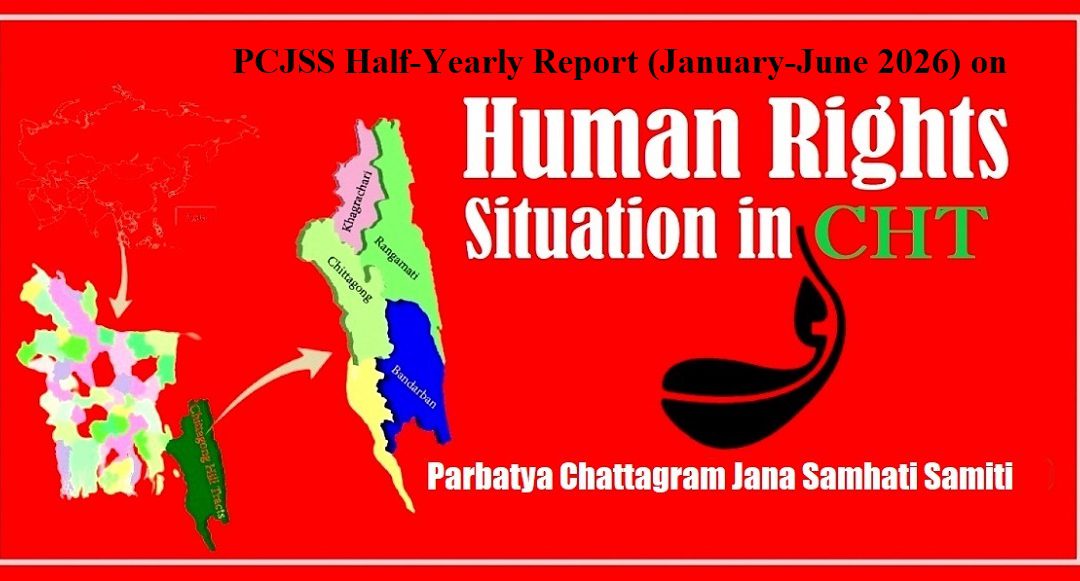
From January to June 2026, 57 human rights violations were committed by security forces and law enforcement agencies deployed in the CHT, army-backed armed terrorist groups, communal and fundamentalist groups, Muslim Bengali settlers and land grabbers, and 154 Jumma people were subjected to human rights violations in these incidents. 10 people were killed in these incidents.
Of the 57 incidents, 24 were committed by security and law enforcement agencies, resulting in at least 45 victims of human rights violations and involving patrol operations in 21 villages. Additionally, initiatives have been undertaken to establish 34 new BGB camps.
Out of 57 incidents, 12 were perpetrated by army-created armed terrorist groups—such as the UPDF (Prasit faction), the Marma Liberation Party (known as the ‘Mog Party’), and the Kuki-Chin National Front (KNF, known as the ‘Bawm Party’)—resulting in 27 people falling victim to human rights violations, including two killings. These violations encompassed incidents such as abduction, ransom, physical assault, killing, gunshot injuries, searches, death threats, theft of money and mobile phones, and demands for extortion.
The UPDF has intensified a Goebbelsian smear campaign—using both official and anonymous accounts on social media—against JSS leaders and activists. Furthermore, they are conducting “malicious and defamatory” propaganda against a dozen civil society individuals, including eminent academician and cultural figure Shishir Chakma (President of the Jum Aesthetics Council/JAC), Pradhir Talukdar Rega (Metta Tour and Travel), Injeb Chakma (Director of the Chakma Literature Academy), Police Sergeant Priyadarshi Chakma, and Chittagong University students Pahela Chakma, Augustina Chakma et al. Widespread protest against this propaganda by the UPDF emerged on social media.
Out of 57 incidents, 10 were perpetrated by Bengali Muslim settlers, land grabbers and Rohingya terrorists, resulting in 69 Jumma people falling victim to human rights violations—including four deaths and 43 injuries. In one instance of a communal attack, false cases were filed against 10 Mro villagers who had actually been the victims of an assault by settler and Rohingya attackers. Additionally, 21 Rohingyas were apprehended by law enforcement agencies while infiltrating Bandarban.
The process of converting members of Jumma ethnic groups—particularly the Mro, Tripura, and some Chakma communities—to Islam by exploiting their poverty remains active across various upazilas of Bandarban district. Serious allegations have emerged regarding the practice of taking young, impressionable children away under the pretext of providing education and enrolling them in madrasas in locations such as Dhaka, Chattogram, Gazipur, Cox’s Bazar, and within Bandarban itself; there, they are reportedly converted to Islam and made to abandon their ethnic identities—including their names and traditional attire—without the knowledge or consent of their parents or guardians.
Some instances of human rights violations are mentioned below—
Oppression and persecution by the administration and security forces:
From January to June 2026, out of 57 recorded incidents, 24 were perpetrated by security and law enforcement agencies—resulting in at least 45 individuals falling victim to human rights violations—and patrol operations were conducted in 21 villages. Initiatives have been undertaken to establish 34 new BGB camps.
On January 16, under the leadership of Maini Zone Commander Lt. Col. Mir Morshed (SPP, PSC) and Sub-Zone Commander Major Rifat Uddin Ahmed Leon (Bengal ‘Tejaswi 3 Bir’), the army conducted extensive operations across several villages in Sarowatuli Union, Baghaichari Upazila, within the Rangamati Hill District.
On January 20, a group of BGB led by Md. Taskin—CO of the Rajnagar Zone (37 Battalion BGB) in Longadu Upazila—unjustly seized approximately 1,000 cubic feet of teak timber from Sarowatali Mouza in Sarowatali Union, Baghaichari Upazila; the wood had been felled by Jumma villagers for development purposes.
On January 24, the Bangladesh Army—led by Major Atiq and Subedar Mosharraf of the 26-ECB—demolished two Jumma houses that were under construction in the Gachbagan Para area of Bilaichari Upazila, Rangamati District. On January 27, the Bangladesh Army again burned down the Jum (swidden) cultivation plot of a Jumma villager in the Gachbagan Para area. The Army continues to obstruct Jum cultivators in this manner with the aim of establishing a tourism center in the Gachbagan Para area.
On January 28, a group of 100–200 personnel from the Alikadam Army Zone and the Bolipara Battalion (38 BGB) camp divided into three groups—comprising 20–30 personnel for Gyanalal Para, 30 for Brahmadatta Para, and approximately 40–50 for Kyachu Para—and conducted harassing search operations targeting ordinary Jumma villagers in these settlements.
On March 16, a joint force comprising the Army, BGB, and Ansar conducted a massive military operation in the Tanikkapara area of Taindong Union, Matiranga Upazila, Khagrachari Hill District, under the command of Matiranga Army Zone Commander Lieutenant Colonel Md. Masud Khan and Matiranga Zone officer Md. Faruk.
On April 11, the Jum (shifting cultivation plot) belonging to Khinwai Mro—a resident of Krilai Para village in Ward No. 6 of Kurukpata Union, Alikadam Upazila, Bandarban District—was looted and damaged by the Forest Department.
On May 7, a joint military operation was conducted by the Army and the BGB in various Jumma-inhabited villages within Logang Union, Panchari Upazila, Khagrachari District. The operation was led by Major Ayan (Commander of the Panchhari Sub-zone), Captain Mahfuz (Commander of the Dumbil temporary army camp), and Md. Ibrahim (Commander of the Dhudhukchara BGB camp). During this operation, the homes of two Jumma villagers were subjected to extensive searches, and one villager was subjected to inhumane physical assault.
The 27 BGB Marishya Zone and 37 BGB Rajnagar Zone attempted to usurp the Jum (shifting cultivation) land belonging to three Jumma villagers and obstructed them from practicing Jum cultivation in Chiba Baro Harina Mouza of Baro Harina Union, Barkal Upazila, Rangamati District. This attempt to forcibly seize the land is being made under the pretext of establishing a BGB camp.
On May 14, the commander of the Jaksha Bazar Army Camp—under the control of the Banjogichara Army Zone—obstructed activists from putting up posters for the PCP (Pahari Chhatra Parishad) in Jurachari Upazila of Rangamati District. Two student leaders were detained for the time being, harassed, and threatened during the incident.
A decision has been made to establish 34 additional Border Outposts (BOPs) for the BGB along the Bangladesh-India border across the three hill districts of the CHT. In accordance with this plan, initiatives have been launched to set up one BOP by the Rishi Para Camp (under the 27 BGB Marishya Zone in Baghaichari Upazila, Rangamati), and two BOPs by the Majhi Para Camp and Thalchara Camp (both under the 37 BGB Rajnagar Zone in Longadu Upazila).
Additionally, three new BGB camps are being established in the Logang and Chengi Unions of Panchari Upazila, Khagrachari, on lands seized from the local Jumma people; these are being set up under the supervision of the Khagrachari Battalion (32 BGB) and the Panchari Zone (3 BGB).
Starting on May 28, a group of army comprising 30 personnel led by Captain Ryan—deployed from the Thangthoithang Army Camp in Farua Union (under the 32 Bir Dighalchari Zone)—conducted a four-day operation across various villages in Ward No. 1 of Barathali Union, Bilaichari Upazila, Rangamati District.
Activities of an army-backed armed terrorist group:
To obstruct the implementation process of the CHT Accord, the army have been creating a succession of armed terrorist groups by recruiting opportunists, collaborators, and unruly elements from among the Jumma people. Prominent among these armed terrorist groups are the UPDF (Prasit), the Marma Liberation Party (known as the ‘Mog Party’), and the Kuki-Chin National Front (KNF, known as the ‘Bawm Party’). Even under the current BNP government, the army continues to unleash these armed terrorist groups against members and supporters of the PCJSS, as well as against other organizations and individuals campaigning for the implementation of the CHT Accord. In particular, there has been a recent surge in fabricated propaganda, killings, and abductions perpetrated by the UPDF (Prasit) against members and supporters of the PCJSS.
From January to June 2026, out of a total of 57 incidents, 12 were carried out by army-created armed terrorist groups; these incidents resulted in 27 individuals falling victim to human rights violations, including two killings. The reported human rights violations included abductions, extortion (ransom and general demands), physical assaults, killings, gunshot injuries, searches, death threats, theft of cash and mobile phones, and demands for extortions.
On January 9, armed terrorists from the army-backed ‘Mog Party’ attempted to shoot and kill Nisaung Marma (55) in Thongjama Para, Rajvila Union, Bandarban Sadar Upazila.
On February 7, an innocent villager was abducted by armed UPDF terrorists from Machyachara in Logang Union, Panchari Upazila, Khagrachari District. The abductee was released ten days later in exchange for a ransom of one lakh taka.
On February 11, three Jumma villagers were abducted from the Shilchari area of Barmachari in Lakshmichari Upazila, Khagrachari district, and another Jumma person was abducted from the Kutukchari Non-Government Primary School polling center in the same union by armed terrorists belonging to the UPDF (Prasit) faction.
On February 13, two innocent Tripura villagers from the Sindukchari Punkhi Para area of Guimara Upazila, Khagrachari district, were beaten by armed terrorists of the UPDF (Prasit) faction.
On March 11, an innocent villager was abducted and beaten by the UPDF (Prasit faction) terrorist group in Babuchara Union, Dighinala Upazila, Khagrachari. On the same day, a Jumma woman was subjected to assault and threats by UPDF (Prasit faction) terrorists in Babuchara Union.
On March 27, Nitidatta Chakma (48) was killed in a surprise burst of gunfire by armed UPDF (Prasit faction) terrorists at Sutakarma Para in Panchari Upazila, Khagrachari District.
On April 1, two youths were severely beaten by a collector for the UPDF (Prasit faction) in Guimara Upazila, Khagrachari District, for paying a smaller amount than demanded as the annual license fee (pass) for their cattle and goat trading business.
On April 19, four Jumma youths—including two motorcycle riders from the Baghaichari area—were abducted by UPDF (Prasit) terrorists from an area known as Ajalchug Amtala, located near the Baghaichari-Dighinala road in Baghaichari Upazila, Rangamati district.
In the early hours of June 10, armed UPDF (Prasit) terrorists burned down approximately 800 maunds (40 kgs per maund) of dried turmeric belonging to five Tripura villagers at a location known as Kaluchara (Boat Ghat) in Sajek Union, Baghaichari Upazila, Rangamati district.
Land Grabbing, Eviction, and Communal Attacks:
From January to June 2026, out of 57 recorded incidents, 10 were perpetrated by Muslim Bengali settlers, land grabbers and Rohingya terrorists; these incidents resulted in 69 Jumma people falling victim to human rights violations, including four deaths and 43 injuries. In one instance of a communal attack, false cases were filed against 10 Mro villagers—who were themselves the victims of an assault by settlers and Rohingyas. Additionally, 21 Rohingyas were apprehended by law enforcement agencies while infiltrating Bandarban.
On January 14, settlers arrived to seize Jumma land at a location known as Khalpar within Headman Para, under Kamalchari Union in Khagrachari Sadar Upazila. When Jumma villagers attempted to resist, Muslim settlers attacked three Jumma villagers with sharp weapons. Among the victims, Bimal Tripura (37) subsequently died while undergoing treatment at Chittagong Medical College Hospital.
On January 17, at least 17 people were injured in two separate attacks carried out by Rohingya terrorists and Bengali settlers against the Mro indigenous people of Janali Para—located near the school in Ward No. 9 of Nayapara Union, Alikadam Upazila, Bandarban District. Subsequently, on February 8, the Rohingya and settler attackers filed a case against 10 of the victimized Jumma villagers in the Court of the Chief Judicial Magistrate, Bandarban, alleging various false charges including attempted murder and death threats.
On January 24, three Tanchangya villagers were beaten by Rohingya terrorists in Ghumdhum Union, Naikhongchari Upazila, Bandarban District.
On January 28, a Tanchangya villager was abducted and severely beaten by a Rohingya terrorist group known as the “Nuru Group” in the Fatrachari area of Ward No. 8, Ghumdhum Union, Naikhongchari Upazila, Bandarban District.
On February 26, Md. Jahirul Islam—a former mayor of Lama municipality and Awami League leader—attempted to construct a resort by forcibly occupying the cremation ground and homesteads of the Tripura community in Mirinja Bagan Para, Lama Sadar Union, Lama Upazila, Bandarban District.
On April 13, during the Biju festival, an altercation occurred in the Ghagra Bazar area of Kawkhali Upazila, Rangamati District. While traveling from Ghagra Bazar to Champatali, Jumma youths protested against a settler Bengali CNG driver who demanded an excessive fare; consequently, Bengali settlers attacked and beat the Jumma people. At least 20 Jummas were injured in the incident.
Recently, in Mangu Mouza (Ward No. 9, Chaikhyong Union, Alikadam Upazila, Bandarban District), a group led by Abuhan Md. Ismail Saudagar—acting in collusion with the Lama-Alikadam Forest Department—has been systematically felling trees and destroying the local forest for long time. This large-scale deforestation poses a threat to the area’s biodiversity.
Between March 31 and April 2, a group of Bengali settlers arrived en masse and cleared the jungle with the intent of encroaching upon land belonging to the Mouza Headman in Chailyatali Union Longadu Upazila, Rangamati District.
On April 22, Samungching Chakma (44)—a local indigenous Chakma villager—was abducted and subsequently brutally murdered by armed Rohingya terrorists while he was searching for crabs to earn a livelihood in Palangkhali Union, Teknaf Upazila, Cox’s Bazar District.
On May 5, 21 Rohingyas were detained during a search at an army checkpoint in Bandarban district town; Rohingyas are continuously infiltrating the Bandarban area in this manner.
On May 24, three Jumma villagers—Chikhang Chakma (44), Chopoching Chakma (47), and Aungkyamong Tanchangya—were killed by a landmine explosion near Pillar No. 42 at Tumbru, in the Bhalukiya Para area of Ghumdhum Union, Naikhongchari Upazila, Bandarban district; the mine had been planted by the armed Rohingya organization ARSA.
On June 21, Bengali land grabbers launched an armed attack on Tripura villagers and attempted to set fire to their homes in Gazalia Union of Lama Upazila, Bandarban, an incident stemming from an attempt to forcibly seize land that the indigenous Tripura community had long held and cultivated.
Ongoing Process of Conversion to Islam Exploiting Poverty in Bandarban:
A process of converting Jumma people—particularly the Mro, Tripura, and some Chakma ethnic groups—to Islam by exploiting their poverty remains active across various upazilas of Bandarban district. Conversions are being driven by the allure of financial benefits, educational opportunities for children, healthcare, housing assistance, livestock rearing support, and interest-free loans.
Serious allegations have emerged regarding young, impressionable children being taken away—under the pretext of providing education—and enrolled in various madrasas in Dhaka, Chattogram, Gazipur, Cox’s Bazar, and Bandarban. There, they are reportedly converted to Islam and made to abandon their ethnic identities, including their names and traditional attire, often without the knowledge or consent of their parents or guardians.
Allegations and various pieces of evidence indicate that several outsider Bengali Muslims and recent converts to Islam are involved in a conspiracy to convert various Jumma families and children to Islam. Individuals reportedly active in this process include Maulana AKM Ayub Khan, JMB Shamim (Md. Yusuf Ali), Hafez Maulana Salamatullah, Farid Ahmed, Abul Kalam, Md. Zahid, Sahab Uddin, Maulana Imran Habibi, and Mohammad Ayub, among others.
Meanwhile, among the indigenous converts to Islam involved in these conversions, those identified include Md. Shahid (a Chakma convert), Moulvi Helal Uddin Tripura, Saiful Islam Tripura (a convert and teacher at Muslim Para Model Academy), Abu Bakkar Siddique (formerly Atiram Tripura), Md. Abdur Rahim of Khagrachhari (formerly Vincent Chakma), Md. Abdur Rahman (formerly Bhonda Chakma), and Md. Ibrahim (formerly Bhabat Chakma), among others.
Currently, there are more than ten settlements or neighborhoods inhabited by converted tribal Muslims across various areas, including Bandarban Municipality, Alikadam, Rowangchari, and Lama. These converts are referred to as “Nao-Muslims” (new Muslims) or “Tribal Muslims.” These settlements serve as bases, and by extending benefits to select converts, ongoing efforts are being made to expand the conversion of simple, unassuming Jumma people to Islam.
It is also worth noting that several settlements for tribal converts have already been established in Bandarban under the banners of organizations such as the “Tribal Muslim Ideal Association,” “Tribal Muslim Welfare Organization,” and “Tribal Ideal Association Bangladesh.” Activities aimed at converting Jumma people to Islam are being conducted through these organizations.
Violence Against Women and Girls:
During the first six months of 2026 (January–June), incidents involving the rape, murder after rape, attempted rape, harassment, and deception of Jumma women and girls—perpetrated by Bengali settlers, migrant Bengali workers, and other individuals—intensified significantly. From January to June 2026, out of a total of 57 incidents, 11 acts of violence were committed against Jumma women and girls by state and non-state actors, resulting in 13 Jumma women and girls falling victim to human rights violations.
In a case of horrific deception, an indigenous Marma young woman from Bandarban Sadar Upazila was taken to Cox’s Bazar by a youth named Mong Marma under the pretext of a trip; she was then handed over to Md. Rubel Hossain (28) and his wife Numew Marma (25) in exchange for a large sum of money, subsequently enduring gang rape and forced involvement in sex work for a month.
On January 19, a group of six to seven individuals led by UP member Kamal Uddin abducted a 17-year-old indigenous Chakma girl from Palongkhali Union in Ukhiya Upazila, Cox’s Bazar district. On March 1, the abducted girl was rescued from the Hnila area of Teknaf during a joint operation conducted by the Ukhiya police and RAB (Rapid Action Battalion).
On February 26, a 15-year-old indigenous Jumma girl with an intellectual disability was raped by an outsider Bengali mechanic in Sajek, Baghaichari, Rangamati district.
On March 9, Ramra Marma (41), an indigenous housewife, was hacked to death by terrorists in Barabil village, Manikchari Upazila, Khagrachari district.
On March 19, Ramesing Marma (30) and her daughter Brishti Marma (4) were murdered in the Meghla tourist area of Bandarban Sadar Upazila. Their bodies were recovered from a 150-foot-deep ravine in a remote section of the Meghla Lalmohan Bagan Tanchangya Para area.
On March 23, a Marma housewife was subjected to an attempted rape by a Bengali settler named Md. Mizan (34) in Fakirnala village, under Manikchari Union in Manikchari Upazila, Khagrachari District.
On April 1, Reshmi Tripura (6), a first-grade student, was severely beaten and injured inside the classroom by Md. Faridul Alam, an assistant teacher at Bochapara Government Primary School in Ward No. 2 of Gazalia Union, Lama Upazila.
On the night of April 11–12, 2026, a 16-year-old indigenous Chakma girl named Maya Chakma was smothered to death with a pillow after a failed rape attempt in Ramu, Cox’s Bazar. This barbaric incident occurred while she was working as a domestic helper for the family of one Sadhan Barua.
On April 20, a 17-year-old Jumma girl was subjected to harassment by Md. Al Amin (24)—a Bengali rubber plantation worker from outside the area—while she was on her way to Tungkhyong Para in Bakicharamukh, located in Bandarban Sadar Upazila.
On April 23, an attempt was made to rape a 12-year-old Mro girl by a Bengali settler named Md. Russel in Danrai Para, Ward No. 1, Thanchi Sadar Union, Thanchi Upazila, Bandarban District.
On May 15, a 16-year-old Chakma girl with a disability was raped by a Bengali fish trader named Md. Saiful in Bandukbhanga Union, Rangamati Sadar Upazila.
On April 23, an attempt was made to rape a 12-year-old Jumma student (in the 9th grade) by a Bengali settler named Abdul Gafur Sheikh (62) in the Hospital Ghat area of Bilaichari Sadar Upazila, Rangamati district.
On May 23, a 5-year-old indigenous Tripura child was raped by a Bengali settler named Bijoy Barua (16) in Thanchi Sadar Union, Thanchi Upazila, Bandarban district.